

One of the best features of Linux server is IPTables , For Network Engineers who are looking to understand the complexities in technology like eBPF, IPTables is an familiar starting point where the concepts like Packet Handling in the Kernel. I want to outline some details but bring it back to some practical use cases . My goal is to provide some practical iptables use but to also explains the tables in iptables and it actually functions.
IPTables Basics
Lets start with the basics, First of all iptables is a well basically a firewall , it helps control traffic policy across a device. How can I see some basics about iptables ?
| Command | Description |
| iptables -L | List all “Firewall” Filter Rules |
| iptables -L –line-numbers -v | List all Filter rules with line numbers and number of packets that have hit the rule |
| iptables -I INPUT 3 -p icmp -j ACCEPT | Insert Accept ICMP to INPUT Table for rule number 3 |
| iptables -A INPUT -m conntrack –ctstate RELATED,ESTABLISHED -j ACCEPT | append rule to table for all related or established connections |
| iptables -I INPUT 1 -m conntrack –ctstate RELATED,ESTABLISHED -j ACCEPT | same rule only INSERTING it to position 1 of the input table |
| iptables -A INPUT -j LOG –log-prefix “iptables INPUT: ” –log-level 4 | log events in syslog |
| iptables-save | save iptables config changes |
| iptables -t nat -A POSTROUTING -o eth0 -j MASQUERADE | Simple NAT all traffic to eth0s ip address (ideal for public ip) |
| iptables -P INPUT DROP | default deny INPUT |
| iptables -P OUTPUT DROP | default deny OUTPUT |
| iptables -P FORWARD DROP | default deny FORWARD |
Below is an example of the FILTER table and two CHAINS Input and Forward
Chain INPUT (policy ACCEPT 0 packets, 0 bytes)
num   pkts bytes target     prot opt in     out     source               destination
1       30  2000 ACCEPT     all  --  any    any     anywhere             anywhere             ctstate RELATED,ESTABLISHED
2      17M  170G LIBVIRT_INP  all  --  any    any     anywhere             anywhere

Chain FORWARD (policy ACCEPT 0 packets, 0 bytes)
num   pkts bytes target     prot opt in     out     source               destination
1     196K   14M DOCKER-USER  all  --  any    any     anywhere             anywhere
2     196K   12M DOCKER-ISOLATION-STAGE-1  all  --  any    any     anywhere             anywhere
3        0     0 ACCEPT     all  --  any    br-812f849fdf89  anywhere             anywhere             ctstate RELATED,ESTABLISHED
4        0     0 DOCKER     all  --  any    br-812f849fdf89  anywhere             anywhere
5     196K   12M ACCEPT     all  --  br-812f849fdf89 !br-812f849fdf89  anywhere             anywhere
6        0     0 ACCEPT     all  --  br-812f849fdf89 br-812f849fdf89  anywhere             anywhere
7        0     0 ACCEPT     all  --  any    docker0  anywhere             anywhere             ctstate RELATED,ESTABLISHED
8        0     0 DOCKER     all  --  any    docker0  anywhere             anywhere
9        0     0 ACCEPT     all  --  docker0 !docker0  anywhere             anywhere
10       0     0 ACCEPT     all  --  docker0 docker0  anywhere             anywhere
11       0     0 LIBVIRT_FWX  all  --  any    any     anywhere             anywhere
12       0     0 LIBVIRT_FWI  all  --  any    any     anywhere             anywhere
13       0     0 LIBVIRT_FWO  all  --  any    any     anywhere             anywhere
Tables , Chains & Rules

Now There is Multiple tables in IPTables , right so what are they?
The most common is filter since that is responsible for the traditional IP Tuple of Firewall access but there is 5 in total FILTER , NAT , MANGLE , RAW , SECURITY
| Table | Command to view | Description |
| Filter | iptables -t filter -L | Accepts / Rejects Packets |
| NAT | iptables -t nat -L | used to modify the source or destination IP addresses. |
| Mangle | iptables -t mangle -L | can perform general-purpose editing of packet headers, but it is not intended for NAT |
| Raw | iptables -t raw -L | allows for packet mutation before connection tracking and other tables are handled |
| Security | iptables -t security -L | SELinux uses the Security table for packet handling |
Now that we understand there is multiple tables , we need to know about the different chains inside each table. Important is to understand iptables was created jointly with Netfilter. Netfilter is a framework of kernel hooks which allow userspace programs to handle packets on behalf of the kernel. Netfilter has 5 Hooks and those hooks are chains
| Netfilter Hook | Iptables chain | Description |
| NF_IP_PRE_ROUTING | PREROUTING | Triggers when a packer arrives from an external system |
| NF_IP_LOCAL_IN | INPUT | When packet is destined for ip on the machine |
| NF_IP_FORWARD | FORWARD | Packets where src/dst is NOT machine IP. Machine is routing on behalf |
| NF_IP_LOCAL_OUT | OUTPUT | Packet originating from machine leaves |
| NF_IP_POST_ROUTING | POSTROUTING | When ANY packet leaves the machine |
Examples of Packets through tables , chains and rules
The last idea I want to share is that not every tables has every chain since the purposes vary on the context. Last item is lets look at some examples, lets start with a topology from Netlab We are going to focus on the left side of the diagram Servers H3 and Server1 are running Ubuntu with IPTables enforcement. Devices ISP1 and LABSW1 are running FRR BGP and act as routers in this build
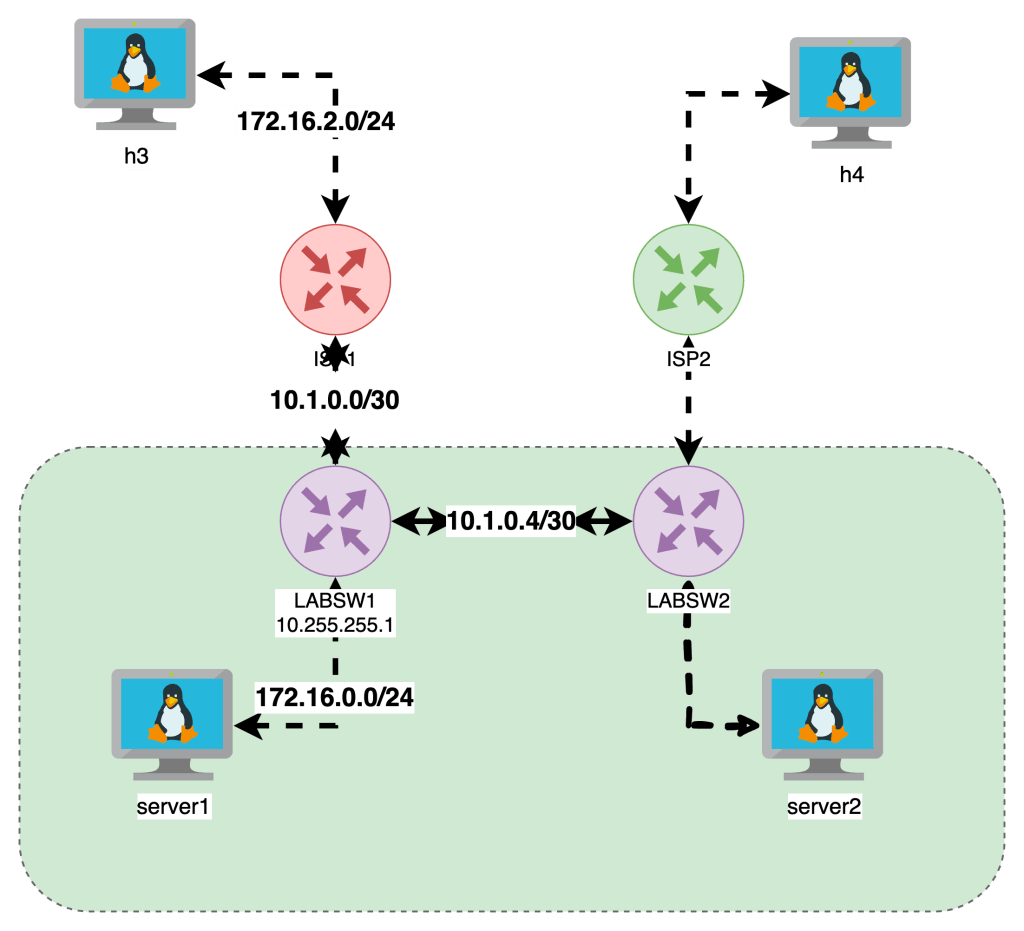
Here is the iptables on server1
server1:/# iptables -L -v --line-numbers
# Warning: iptables-legacy tables present, use iptables-legacy to see them
Chain INPUT (policy DROP 69 packets, 5796 bytes)
num   pkts bytes target     prot opt in     out     source               destination
1     2409 3203K ACCEPT     all  --  any    any     anywhere             anywhere             ctstate RELATED,ESTABLISHED
2        0     0 REJECT     tcp  --  any    any     anywhere             anywhere             state INVALID reject-with icmp-port-unreachable
3        1    84 ACCEPT     icmp --  any    any     anywhere             anywhere
4       75  6268 LOG        all  --  any    any     anywhere             anywhere             LOG level warn prefix "iptables INPUT: "
5       74  6184 LOG        all  --  any    any     anywhere             anywhere             LOG level warn prefix "iptables INPUT: "

Chain FORWARD (policy DROP 0 packets, 0 bytes)
num   pkts bytes target     prot opt in     out     source               destination

Chain OUTPUT (policy DROP 3 packets, 252 bytes)
num   pkts bytes target     prot opt in     out     source               destination
1        9   756 ACCEPT     icmp --  any    any     anywhere             anywhere
The INPUT , NAT & OUTPUT have DENY as the default Rule as well as explicit allow rules for ICMP traffic to allow for this example
Server1 has ip 172.16.0.5 and is pinging across to h3 172.16.2.7. The INPUT table shows packets hit for RELATED and ESTABLISHED as well as the OUTPUT table
This is the basics of iptables and look for my next post that expands on these topics.
 Loud Networking